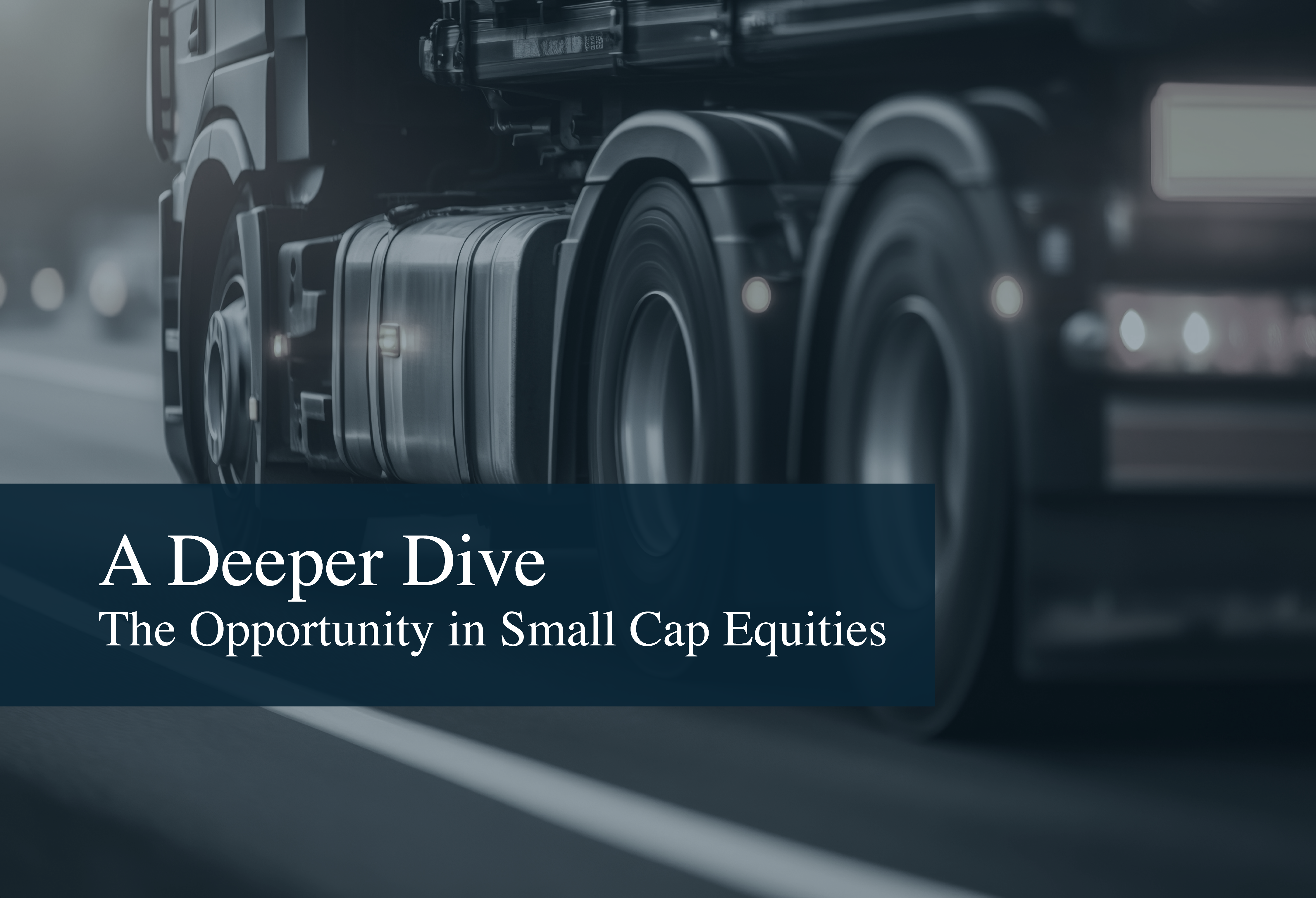
The Opportunity in Small Cap Equities:
A Deeper Dive
The third quarter of 2025 witnessed a comeback for small-cap equities: The Russell 2000 advanced 11%, nearly matching the Nasdaq’s 12% increase and handily outpacing the 8% lift in the S&P 500.1 In our view, the resurgence, particularly in August, was fueled by shifting market dynamics and macroeconomic conditions that favored smaller companies, which, as we noted in our March 2025 piece exploring the opportunity in small cap equities, have been undervalued relative to large cap equities for an extended period.2 Yet this very brief period of outperformance marks a small dent in the significant valuation gap that has persisted between small and large cap equities for over a decade,3 leaving a long runway to capitalize on dislocations between price and value.
The renewed enthusiasm for small caps seems to be driven by more benign macroeconomic narratives that may or may not materialize. In our experience, risk-on sentiment has generally favored shorter duration and more highly leveraged businesses, leaving many remaining pockets of opportunity. One such area where we continue to find investment opportunities we consider compelling is the Transportation industry. While the Industrials sector has performed well recently across the market cap spectrum, small cap stocks in the Transportation industry have largely been left behind.4 Our two largest Industrials-sector holdings, tank barge operator, Kirby Corp. (KEX), and intermodal trucking and logistics provider, Hub Group, Inc. (HUBG), were no exception. Yet for those with a long-term view, we believe these businesses rank at the top of long-term return potential across our investments in the VELA Small Cap Strategy.
It is no secret that the recent backdrop for the U.S. Freight Transportation industry has been challenging. The industry is experiencing a three-year downturn with many important end-markets for freight struggling due to higher rates and tariff uncertainty. For context, the Cass Shipment Index is down 18% from the peak achieved three years ago,5 the ISM Manufacturing Index has been below 50 (in contraction) every month other than two since the beginning of 2023,6 and average housing starts year to date are down 10% from their 2022 average.7 Industrial production metrics have thus been similarly muted over this time frame. In light of these less than inspiring figures, why would we view KEX and HUBG as attractive investments?
To start, both businesses operate in an industry (Transportation) that is essential to all aspects of the US economy, they have strong balance sheets, and they are run by management teams that have a track record of investing capital in an astute, counter-cyclical fashion and the balance sheet flexibility to prolong their records of success. On top of that, KEX and HUBG are delivering robust free cash flow yields on below normalized earnings power. In other words, these businesses are still performing well fundamentally, even amidst a challenging environment. In general, weak demand precipitates tighter supply, which in turn increases industry profitability. In longer cycle industries like Transportation, our long-term view and experience following the industry can be especially beneficial. When the economic backdrop for these businesses does normalize, we believe we have a powerful combination for strong capital appreciation.
Kirby Corp. (KEX): In the case of tank barge operator, KEX, the supply environment is particularly favorable. The industry fleet has contracted each year since 2022, with close to 50 orders for new barges and closer to 75 expected barge retirements from the industry for the year. We anticipate these trends will persist beyond 2025. There is currently not enough shipyard capacity in the US to build more than 50-60 barges per year, and retirements generally range from 50-150 ships annually. Our research work and conversations with KEX management indicate that at least a 30% increase in barge contract pricing is needed to incentivize growth capacity, with added shipyard capacity required on top of that. Yet even with the more tepid demand conditions we see today, KEX is running at mid-teens margins and generating consistent free cash flow. With this cash flow and a strong balance sheet with around 1.5x leverage, KEX can continue to repurchase stock at discounted prices and/or act on opportunities to continue to consolidate distressed operators at attractive economics. And similar to management, as long as the market continues to overlook the value in KEX, we also work to take advantage of opportunities to consolidate our position in KEX at prices we find attractive.
Hub Group (HUBG): The current supply side of the equation for HUBG, the intermodal trucking and logistics provider, is not as constructive as what we see for KEX. The industry is still working off excess capacity. HUBG, also with a strong balance sheet at less than a turn of leverage and strong free cash flow metrics, has the potential to accrue share from less well positioned and capitalized operators in the industry as capacity is rationalized.
On top of that, we are seeing some green shoots in demand and other indications of favorable structural developments for HUBG. Intermodal volumes are inflecting positively as they convert freight from the competing trucking market. In addition, new rail contracts are keeping margins well above prior troughs during a severe downturn due to more flexible contracts with their rail partners.
We are becoming increasingly constructive on the long-term opportunities to grow intermodal volumes. Recent announcements of rail consolidation/alignment are largely predicated on accelerating conversion from truck to intermodal. HUBG would be one of the largest beneficiaries of the proposed merger between the Union Pacific and Norfolk Southern railroads for a variety of reasons: 1) HUBG’s positioning lines up well as they partner with Union Pacific in the West and Norfolk Southern in the East; 2) HUBG is Union Pacific’s largest intermodal partner; 3) alignment of the two rail networks would reduce transit times, making HUBG’s intermodal service times more competitive with trucks; and last, 4) a Union Pacific/Norfolk Southern combination would create opportunities to convert freight that doesn’t currently make sense to move by rail given locations relative to east/west rail line change offs.
KEX and HUBG are just two examples of businesses we own that are trading at deep discounts to our estimates of normalized earnings potential. Our investments in these businesses also shed light on how we prefer to take cyclical risk. It is not in speculative, highly leveraged businesses with no or erratic free cash flow streams. We seek to make our largest investments in durable, necessary businesses that have ample capital to fund their operations and pursue value-enhancing initiatives at a discount to our estimate of their worth. In this approach, we believe we optimally position our investors to realize favorable, long-term risk adjusted returns.
Disclosures & Definitions:
VELA Investment Management, LLC is an independent investment adviser registered under the Investment Advisers Act of 1940, as amended. Registration does not imply a certain level of skill or training. More information about VELA Investment Management, LLC, including our investment strategies, fees and objectives, can be found in our Form ADV Part 2, and/or Form CRS, which is available upon request.
The views expressed are those of VELA Investment Management, LLC as of 10/02/25 and are subject to change. These opinions are not intended to be a forecast of future events, a guarantee of future results, or investment advice. Information presented is for educational purposes only and does not intend to make an offer or solicitation for the sale or purchase of any specific securities, investments, or investment strategies. Investments involve risk and unless otherwise stated, are not guaranteed. Third-party information in this report has been obtained from sources believed to be accurate; however, VELA makes no guarantee as to the accuracy or completeness of the information.
Be sure to first consult with a qualified financial adviser and/or tax professional before implementing any strategy discussed herein. Past performance is not indicative of future performance.
As of 9/30/2025, Kirby Corporation (KEX) represented 4.5% of the Small Cap Strategy Composite and Hub Group, Inc. (HUBG) represented 3.8% of the Small Cap Strategy Composite. The companies identified above are example holdings and subject to change without notice. The companies above have been selected to help illustrate the firm’s investment process and should not be considered a recommendation to purchase or sell any particular security.
The Russell 2000 Index is an unmanaged market capitalization-weighted index comprised of the smallest 2,000 companies by market capitalization in the Russell 3000 Index, which is comprised of the 3,000 largest U.S. companies by total market capitalization.
The S&P 500 Index is a composite of the 500 largest companies in the United States. The S&P 500 Index is unmanaged and does not represent the performance of any particular investment.
The Nasdaq Composite is a stock market index that includes almost all stocks listed on the Nasdaq stock exchange.
You cannot invest directly in an index.
The Cass Shipment Index is a monthly, real-world measurement of the volume of North American freight shipments
The ISM manufacturing index, also known as the purchasing managers’ index (PMI), is a monthly indicator of U.S. economic activity based on a survey of purchasing managers at manufacturing firms nationwide.
Intrinsic Value is a measure of what an asset is worth, arrived at by means of an objective calculation or complex financial model. Intrinsic value is different from the current market price of an asset. However, comparing it to that current price can give investors an idea of whether the asset is undervalued or overvalued.
Free Cash Flow (FCF) represents the cash a company can generate after accounting for capital expenditures needed to maintain or maximize its asset base.
Return on Equity (ROE) is a measure of a company’s financial performance. It is calculated by dividing net income by shareholders’ equity.
Normalized Earnings or normalized income refers to a company’s income that has been adjusted to remove revenue, expenses, or effects of seasonality.
Footnotes:
1Factset
2,3Hubbard, Jenny, CFA. Why Small Cap Now, Part II: Chaos Creates Opportunity. March 2025. VELA Investment Management, LLC.
4Factset
5Cass Information Systems (as of most recent report, data as of 08/01/25)
6Institute for Supply Management (as of most recent report, data as of 08/31/25)
7US Census Bureau (as of most recent report, data as of 8/31/25)
Author

Jenny Hubbard, CFA
Jun 16, 2020